In the summer of 1926, Donald L. Halverson, then-director of dormitories and commons at UW–Madison, stopped at the Essex Resort Lodge in Tomahawk. At the time, the only thing notable about the northern Wisconsin lodge was that it was closed, and Halverson had been hoping to get a quick meal as he waited out a thunderstorm.
Halverson later said he only asked for a sandwich, but the chef at the lodge insisted on opening up the kitchen and serving him a full meal. Suddenly, the most notable thing about the Essex Lodge was its chef, Carson Gulley, a southern transplant who would eventually become Madison’s first celebrity chef.
Halverson delayed his return to Madison to spend more time with the chef who’d impressed him. An invitation to chat after the meal turned into a 5 a.m. fishing trip, lunch, dinner and most importantly, a job offer.
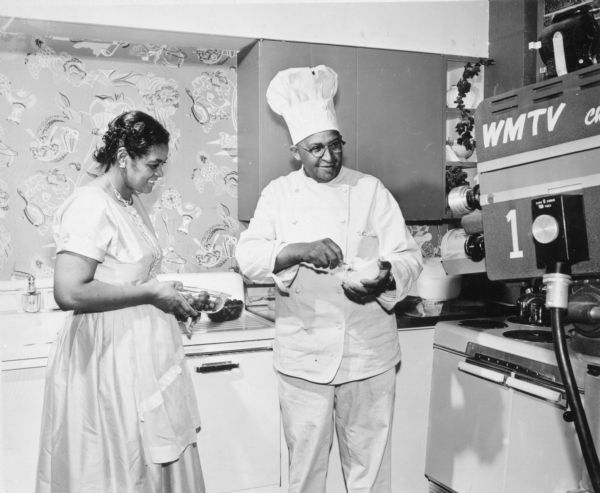
In spite of being a star of the Madison food scene in the 1950s and early 1960s, Gulley struggled to find housing in a city where segregation ran rampant. At one point, Gulley and his family lived in a basement apartment next to the campus building where he worked and that now bears his name, the Carson Gulley Center.
Gulley opened his own restaurant in 1962, but he died less than two months later, leaving him unable to see his business truly flourish. However, decades later, Black-owned restaurants are thriving in Madison, bringing their own love for food to the community.
These days, the Madisonians that are most likely to recognize Gulley’s name are students who lived in residence halls like Tripp, Adams and Slichter and ate at Carson’s Market, a dining hall in the Lakeshore neighborhood of campus.
The building, named after Gulley in 1966, was the first building on UW–Madison’s campus to be named after an African American and the first to be named after a civil service employee.
Though the building bears Gulley’s name and picture when you enter its front doors, many who walk through them are unaware of Gulley’s story and experiences with segregation in Madison.
Before he gained fame for fighting segregation in Madison and breaking color barriers on campus, Gulley did one thing: He made good food. It’s through his love for cooking that Gulley’s legacy has endured — even within his own family.
“At the time of his death, there was, arguably, no better known African American in Wisconsin.”
In the 1920s, Gulley left behind his first wife and four children. It was his second wife, Beatrice, who rose to fame alongside him in Madison. His grandson, Robert Pennie, didn’t know his grandfather well, but he revels in the legacy left behind by his cooking.
Robert Pennie’s wife, Peggy, described how she goes onto Facebook groups connected with the university and still finds those who remember eating Gulley’s food.
Food and family aren’t unique to Gulley; in fact, there’s another Black chef in Madison in Madison with a legacy that runs deep.
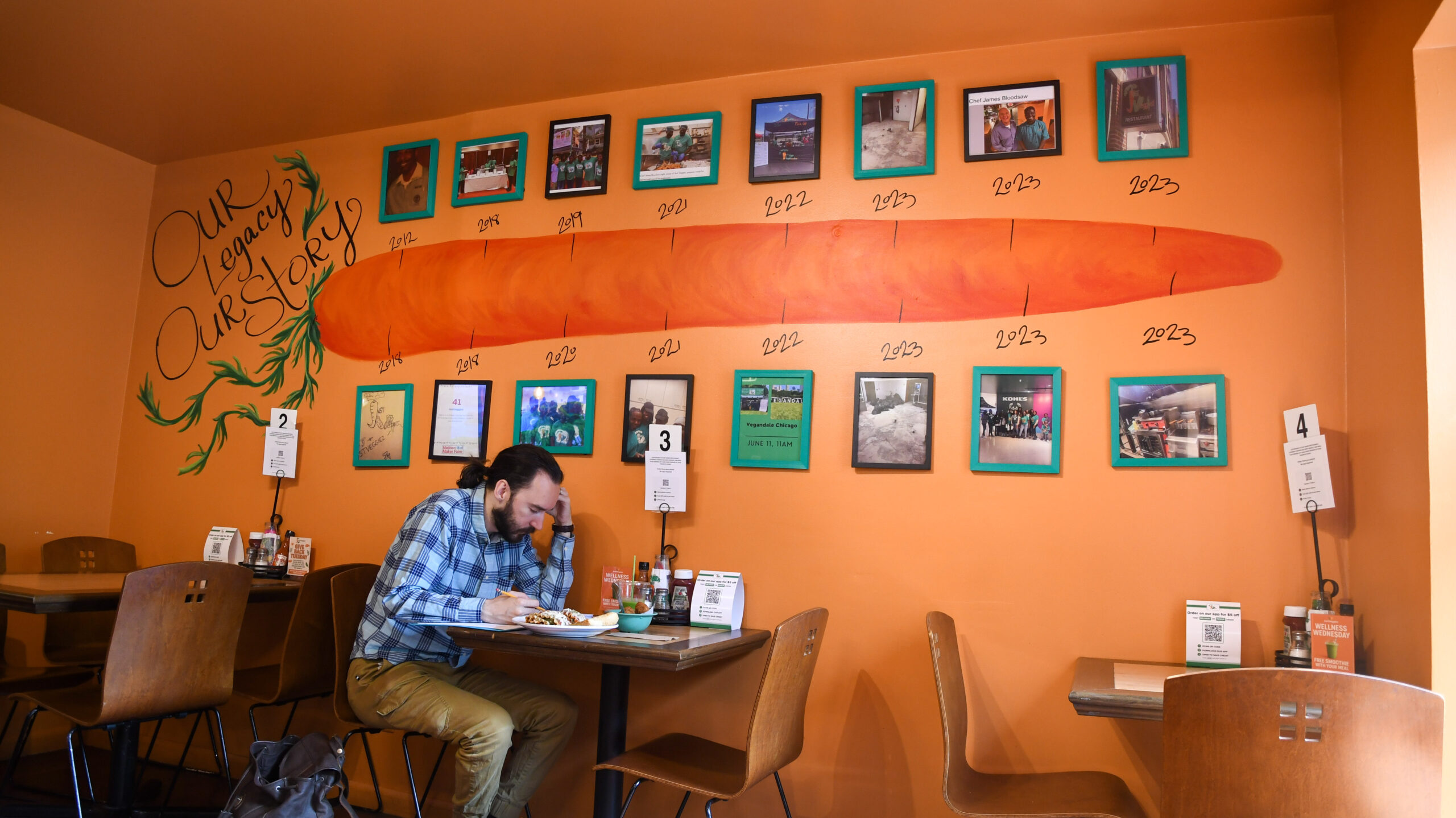
A Vegan Oasis
James Bloodsaw Jr. is the chef and owner of Just Veggiez, a State Street restaurant with a single claim to fame: It’s completely vegan.
Bloodsaw became a vegan before he opened the restaurant, at first because he wanted to cut out fried chicken — but then a family tragedy hit.
Bloodsaw says he found out his father had a range of health issues, and 13 years ago, his father passed away.
“That’s when I changed,” Bloodsaw says.
Bloodsaw’s vegan cooking career started small, serving food at pop-up events around the city before moving on to more events throughout the Midwest, traveling and setting up kitchens on the weekends after his day job.
At first, Bloodsaw didn’t even think about opening a sit-down restaurant — his customer base did it for him. When he worked in a shared kitchen with another small business, they were inundated with calls asking if there was a wait for seats, he says.
“We just [started] getting, I kid you not, two or three calls a day,” he says. “And I was like, ‘Oh, wow. I think I might need a restaurant.”
The Just Veggiez sit-down restaurant opened in the summer of 2023 and serves vegan versions of many classic dishes like pizza, chicken sandwiches and even cheese curds.
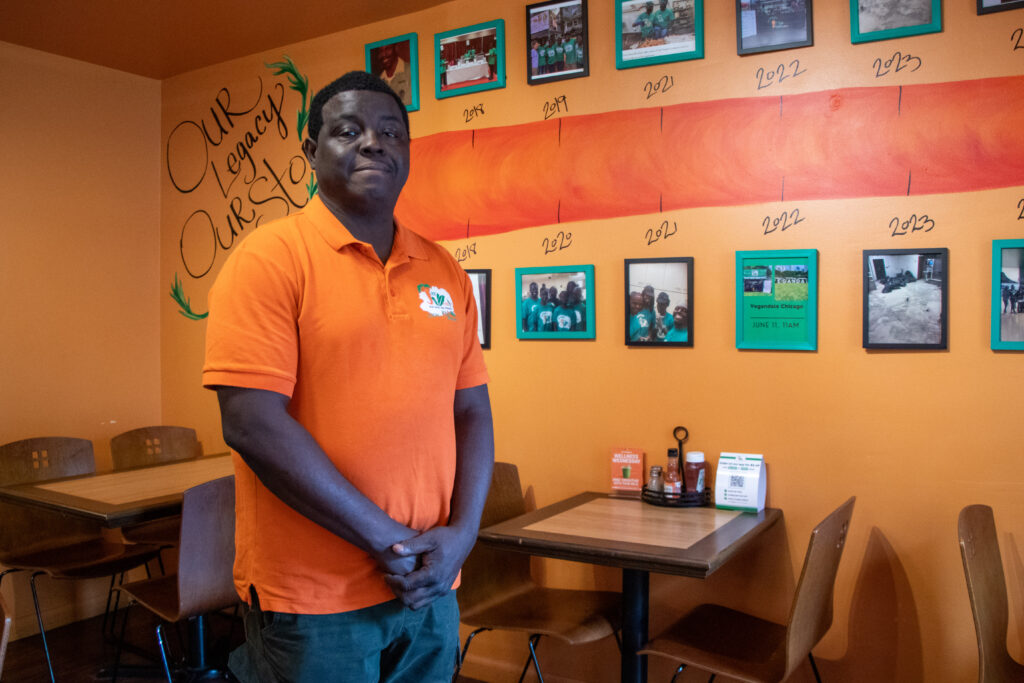
Bloodsaw says that while Just Veggiez is a family business — he works in the kitchen when it gets busy, and his son works behind the counter — there have been challenges to being a Black business owner on State Street.
Early on in the business, Bloodsaw says he worked with contractors to try to take down a wall in the restaurant. Contractors came in, looked at the space and said they would contact him soon with an estimate.
“We’ve been here two years, and I ain’t got the estimate yet,” he says. “95% of the contractors never called me back.”
Bloodsaw says he didn’t think much of it at first.
“Somebody was talking to me, and was like, ‘Did they not call you back because you are Black?’ And I was like, I didn’t think about that,” Bloodsaw says.
Despite the challenges, Just Veggiez is thriving and introducing vegan options to the community. Sometimes, Bloodsaw says, customers come up to the restaurant without knowing it’s vegan, but decide to try something anyway.
“When they get up here, they’re like, ‘Oh, it’s vegan.’ OK, let me try something,” Bloodsaw says.
Even as Gulley’s reputation as a chef in Madison and around the state grew, he still faced the challenges of being an African American in early-20th century America. While he worked at UW–Madison, there were no professors or administrators of color, and segregation was enforced in the residence halls he served.
In Dane County, African Americans were barred from being public school teachers, trying on clothes in some businesses and even sitting down to eat in certain restaurants.
The issue that Gulley struggled with the most was the one that would eventually lead to the building that bears his name: housing.
At the time, many landlords in Madison would not rent to African Americans. The Gulleys tried to buy property but were turned away. They tried to rent housing but were told they didn’t belong. Finally, they’d had enough, and Carson Gulley considered leaving Madison to look for another job.
But Halverson wasn’t ready to let his best chef go, so he built the Gulleys a small apartment in the basement of Tripp Residence Hall. The apartment was right next to the Gulley Center, then named the Van Hise Refectory, where Gulley worked.
The couple lived in the apartment until Gulley retired from the university in 1954.
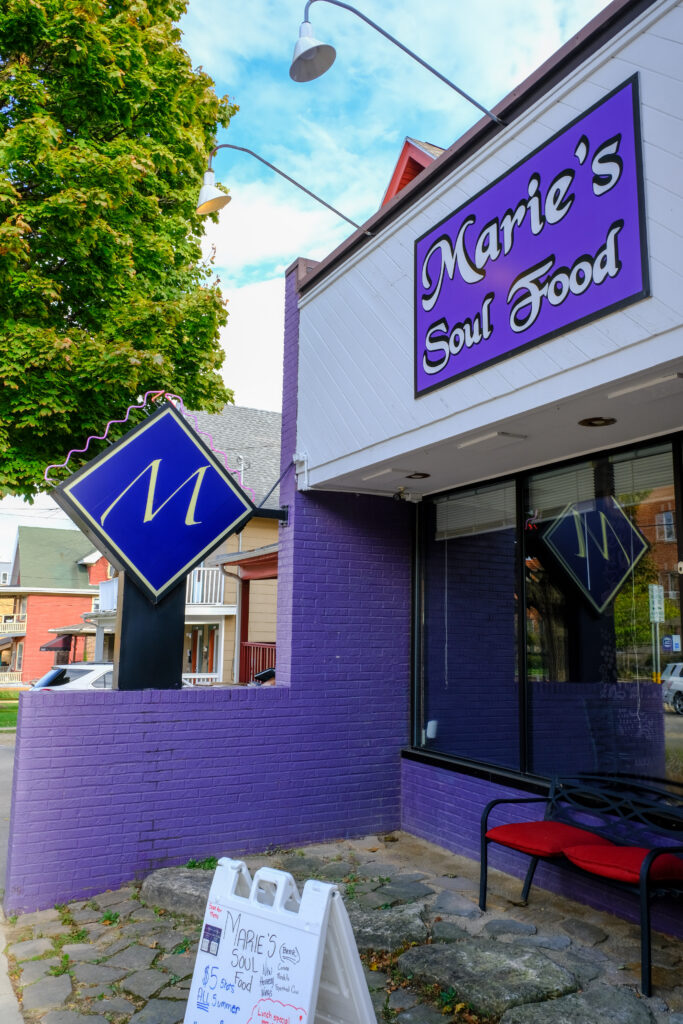
A community spot
Tucked away on Madison’s Monroe Street is a restaurant identifiable by the large purple sign, simply featuring the letter “M,” that adorns the sign outside the building.
It can be easy to miss on a street lined with houses where students mostly walk to Trader Joe’s, but Marie’s Soul Food is a hidden gem.
The restaurant was opened in 2019 by Marissa Holmes.
After working in the restaurant industry as a teenager, Holmes turned to a corporate job. However, as her corporate job began to take a toll on her physical and mental health, her partner suggested that they turn her talents toward opening a restaurant, she says.
“Having headaches coming from work all the time, that was kind of like my push [to] just give it a try. And I did, and the rest is history,” Holmes says.
Marie’s Soul Food serves a limited menu of comfort classics like ribs, fried chicken, mac and cheese, collard greens and fried catfish. Holmes says the restaurant is frequented by students and community members alike, and during family weekend and homecoming, students will bring their partners and siblings to try the food. Marie’s offers a 10% discount for all students who show a valid school ID and a $7 meal deal for students.
“[Students and families] are probably our biggest support system,” Holmes says. “So it’s the least that we can do.”
Holmes says the Monroe Street address picked her. She and her partner were looking for places to house their restaurant and went to what was then Maurie’s Fine Chocolates on Monroe Street. They were told another couple, this one looking to open a Mediterranean restaurant, was also coming in later that day to look at the place. The previous owners met with the couple, but later called Holmes and told her they wanted her to have the space.
“I like to tell this story, because it was called Maurie’s Chocolates … so you remove the U and it spells Marie,” Holmes says. “And the ‘M’ was [already] outside.”
Holmes credits the Madison community for being receptive to the restaurant and the Monroe Street businesses for welcoming them to the neighborhood.
“We couldn’t have done it without Madison,” she says.
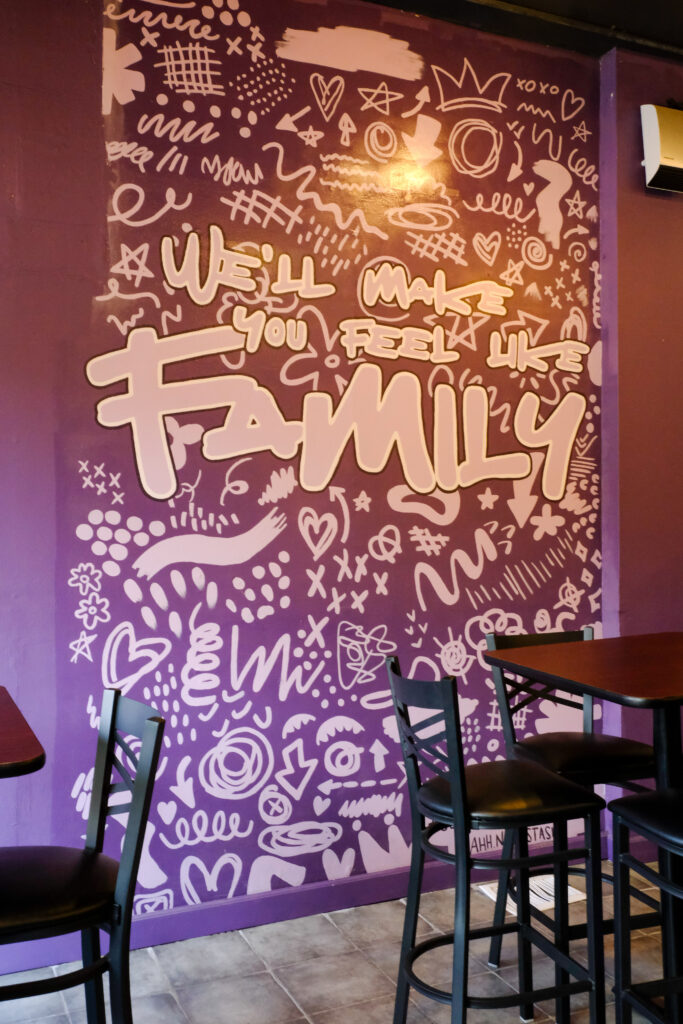
For Gulley, the Madison community of the 1950s wasn’t quite as welcoming.
“There was a lot of racial stuff going on, especially when he got into the private business,” Pennie says.
Gulley retired from the university in 1954 and started his own catering business, Pennie says. By this time, he had moved out of his apartment on campus and finally been able to purchase a home. However, his neighbors wanted nothing to do with him or his burgeoning business.
“They wanted him to get out,” Pennie says.
In 1961, Pennie moved from California to Madison to work with his grandfather, hoping to pursue a career in cooking. Around that time, Gulley moved his catering business out of his home and into a building — which Gulley had built from the ground up, Pennie says — on 5522 University Ave. The first floor was where catering prep was done, the basement served as a restaurant space with table seating and the top floor was a small apartment for the Gulleys to live in, Pennie says.
Pennie says that opening a restaurant wasn’t Gulley’s dream.
“Because he built a building, and he was famous from the university, the community wanted him to have a dining room there,” Pennie says. The restaurant only increased troubles for the Gulleys as they were unable to get a liquor license to serve alcohol.
Two weeks after the restaurant’s opening, Gulley fell ill and went to the hospital, where he passed away a month later. Beatrice ran the restaurant for a few years before selling the property in 1965. The building has since been demolished.
Despite his name living on through Carson’s Market, much of Gulley’s backstory was not collected until 2016, when Scott Seyforth, assistant director for residence life at UW–Madison, wrote an article about Gulley. The article appeared in the Wisconsin Magazine of History, finally compiling photos of Gulley, oral history interviews and a full timeline of his career in one place.
To Seyforth, describing Gulley’s impact is simple:
“At the time of his death, there was, arguably, no better known African American in Wisconsin.”
History in the Kitchen
The legacy of chef Carson Gulley lives on through his recipes
Video by CAMERON SCHNIEDER and GABRIELLA HARTLAUB
Carson Gulley collected many of his most famous recipes in his 1956 cookbook “Seasoning Secrets,” but how many of them can be made in a college student’s kitchen? We attempt to find out by recreating his famous Baked Macaroni and Cheese.
Baked Mac and Cheese Recipe
(Serves 10)
1 pound package macaroni • 1 pound grated, aged Cheddar Cheese • 3 tablespoons butter • 2 tablespoons flour • 2 teaspoons paprika • 1 tablespoon Worcestershire • 2 teaspoons salt • 1 tablespoon salad mustard • 2 cups hot milk • ½ cup buttered crumbs
While macaroni is boiling, make a cream sauce by melting butter, adding flour, paprika, worcestershire sauce, salt, mustard and cooking to a smooth paste over a low fire. Add hot milk to this seasoned roux and cook, stirring constantly until thick. Drain macaroni well, then put it in a buttered casserole alternating with layers of grated cheese. Pour sauce over all, top with buttered crumbs and bake in a 350℉. oven for about 80 minutes.
Feature photo: Gulley smiles out the window of his truck in an ad for his catering company in the 1960s. Photo courtesy of Wisconsin Historical Society