The gentle plucking of violin strings and the wobbly pitch of guitar strings being tuned flood the room of a suburban home on Madison’s west side.
A single, sustained note sputters to life through the horn-end of Fernando Ponce’s trumpet, and the band is called to attention.
The five musicians sit in a circle in Tino Martinez’s cozy living room. The early afternoon sun shines through the frosted windows and the plants along the windowsill. The Martinez family Chihuahuas, Papa and Yuca, wait in anticipation for what is no doubt a regular scene for them.
A count-off and suddenly Ponce’s trumpet blasts four measures of melody throughout the living room. Amairani Zepeda Brito and Jocelyne Real repeat the melody on their violins. Martinez provides the bass on the guitarrón, and his son, Rafa, comes in with the rhythm on the guitar.
Ponce lowers his trumpet and begins to sing.
“En tu pelo tengo yo, el cielo (in your hair, I have the sky),” he sings. Suddenly, Javier Solis’ romantic bolero ranchero — the Mexican music that is characterized by dramatic and passionate lyrics — is in full swing. The music spills out the front door into the neighborhood, announcing itself to Madison, a place where mariachi has never taken root, until now.
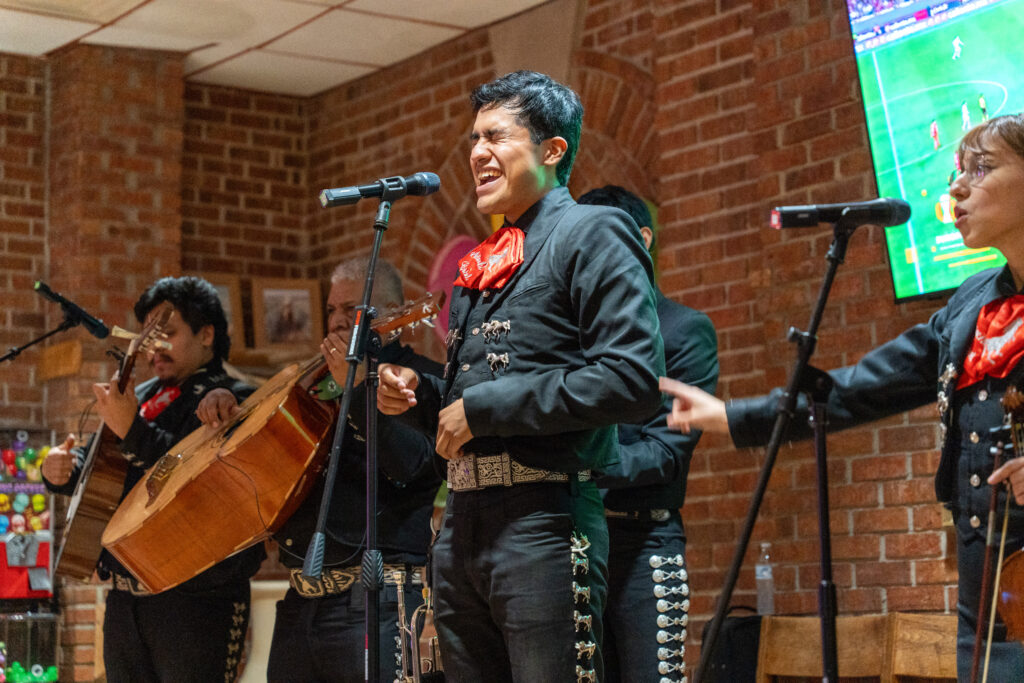
Balancing respect for Mexican heritage with creative experimentation, these musicians wear handmade charro suits imported from Mexico while drawing on influences such as jazz, funk and classical to experiment with their sound. Often playing for audiences that may not have heard mariachi before, they are shaping the future of the genre in a region where such music is still rare.
The current iteration of the band joins several other efforts across the state to normalize mariachi in Wisconsin. These include university initiatives to formalize mariachi in academic spaces like UW–Oshkosh’s “Wisconsin’s Mariachi Academia Popular” and longstanding efforts from nonprofits such as the Latino Arts Strings Program in Milwaukee. Corcel’s journey reveals how music can transcend borders, foster community and keep cultural currents alive far from their origins.
The band comes together
Mariachi Corcel de Madison was co-founded in 2011 by Tino Martinez, the band’s guitarrón player and vocalist, and his son, Rafa Martinez Salas, who plays guitar and also provides vocals. Martinez played with groups in Mexico, California and Madison before deciding to start his own group.
The father-son duo played with various musicians until the group’s current lineup began to coalesce before the COVID-19 pandemic.
Ponce, the group’s lead trumpeter, joined that year following short stints with other mariachi groups, and violinist Zepeda Brito joined the group in August 2022. She had played with them on and off for about a year before joining the roster full time. Shortly after, Jocelyne Real joined as a second violinist and vocalist. Born in Spain and raised in Ecuador, Real is the only non-Mexican member of the band.
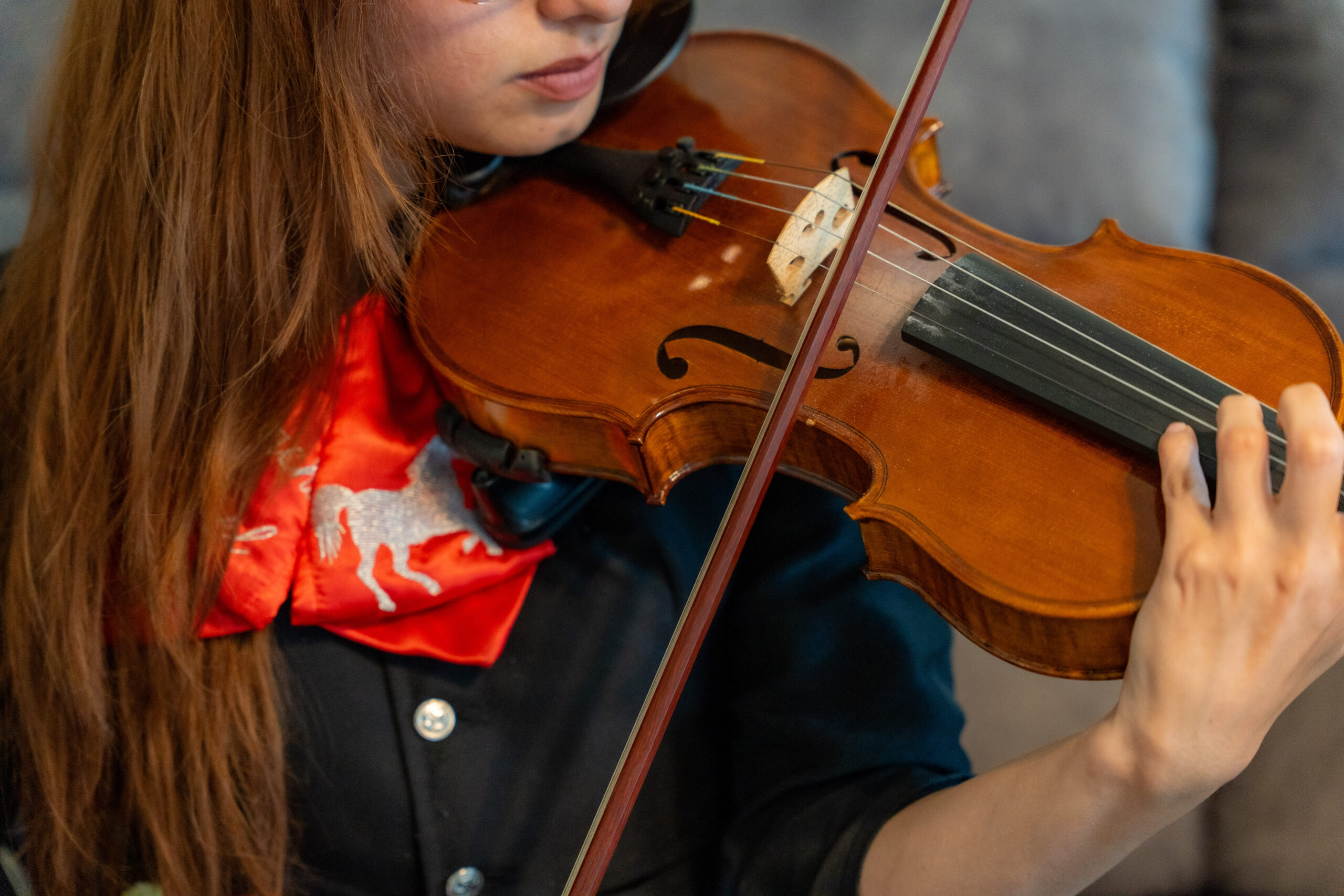
“Even though Mexican music is very popular in all Latin America, I didn’t really play mariachi music before,” she says. “I had to learn a
50-song repertoire in a month.”
Corcel’s identity is elastic by design. Ponce rattles off a repertoire that easily jumps decades and genres: “We play songs that are in English … a version of ‘Can’t Take My Eyes Off of You.’ We play … ‘We Don’t Talk About Bruno.’ We play Lady Gaga, we played Kendrick Lamar, ‘Not Like Us.’”
That range is not just a party trick; it is how the band meets Wisconsin audiences where they are. When they first started, they were mostly hired by Mexican clients who needed a band for private parties or to perform at their businesses. Now, the group finds itself being employed by all kinds of audiences, including people from other Latin American countries such as Colombia and Nicaragua, as well as non-Latino groups.
“We’re showing what mariachi is to people who might have not seen it before.”
Beyond meeting clients where they are, the band’s eclectic music repertoire reflects the individual members’ own special interests. Zepeda Brito and Real are classically trained violinists who will sometimes implement variations — transforming sections of a composition in a modified form — in traditional mariachi songs, which often have many unchanging lines.
“That’s one thing that is fun about having two people that play the same instrument,” Real says. “Sometimes we have to improvise songs … and we don’t know the exact arrangement for the song. So we are like, ‘OK, you play, I’ll listen to you. I’ll try to follow you in back.’ It’s a very fun dynamic between us.”
Ponce, who was born in Mexico and raised in Madison, grew up playing in jazz, funk and school bands. He brings those musical influences to the band, contributing to its overall mass appeal among audiences.
“It’s fun to mix the music together,” he says. “Mariachi is interesting because it’s definitely like balance, it’s very much tradition, but as time progresses, you have to innovate at the same time.”
Being ‘ambassadors’
What Corcel does is musical but also representational. Whether playing for people who have never heard mariachi music or people who grew up with it in another country, but have not heard it since moving to the United States, Corcel wants to represent the genre authentically.
“We’re showing what mariachi is to people who might have not seen it before,” Ponce says. “So now it’s not just us playing music … it’s us being mariachi and showing that image, showing that attitude … it very much is a powerful energy.”
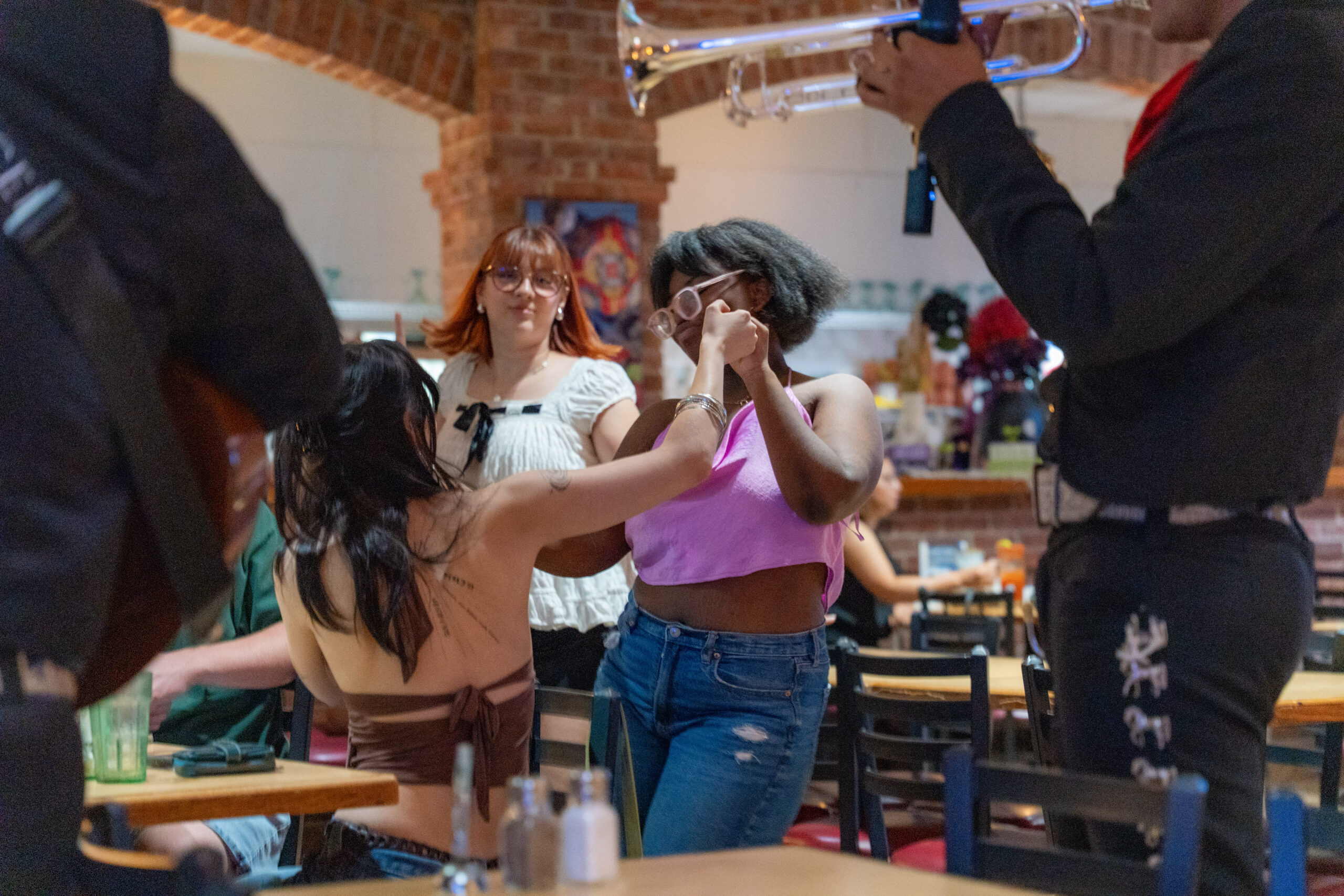
The group’s appearance plays a major role in boosting the authenticity of their brand. They wear traditional “charros,” suits with intricate embroidered designs along the pants or skirts and jackets, historically worn by ranchers. The outfit is brought together with a large bow tie and, in many mariachi bands, can be topped off with a sombrero. The buttons on Corcel’s jackets are in the shape of horses to coincide with their band’s name, which means “steed” in Spanish.
“We’re wearing something that represents Mexico,” Real says. “Our presence … means something, so we have to show ourselves as what we want to represent.”
That sense of duty is especially present when performing for youth. Ponce, an alumnus of Madison’s East High School, says he loves performing at local schools. The moments when kids go quiet and stare at the outfits and instruments remind him of the way he once did when he was a student.
“Now I’m the person playing the music,” he says. “I see the kids looking at us. They’re in awe of the suits [and] the music.”
Mariachi in Wisconsin
Across the state, there is a growing interest in mariachi; however, the infrastructure to support the genre is lacking.
“In one word, I would say the state of mariachi is growing … Another way to describe it would be in flux,” says Juan García Oyervides, director of Chicana/o & Latinx Studies at UW–Oshkosh.
In Fox Valley, an east-central region, García Oyervides used a humanities grant, “Wisconsin Mariachi’s Academia Popular,” to visit ensembles, foster interest and connect mariachi enthusiasts and performers with educators.
“What has happened in the past 10 years or so is unprecedented,” García Oyervides says. “We have [not only] growing interest in mariachi, but also new groups that are coming up … that are particularly led by younger folks.”
He points to Corcel as a clear example of how young bands are shaping the genre here.
“From the outsider perspective, listening to [Mariachi Corcel] play and hearing how they talk about what they do, [there] is this particular interest in innovating, in renovating and reinvigorating,” says García Oyervides. “We see them performing in English. We see the jazz influence … We see it in the way they perform.”
García Oyervides highlights the rise of other Wisconsin bands, like Milwaukee-based Mariachi Monarcas, as potential starting points for building infrastructure to nurture the genre here. These groups, which are led by younger musicians who are classically trained, are poised to pass down knowledge.
“We in [Fox Valley] don’t have a permanent instructor that is able to teach that, that is able to manage that from the educational and artistic perspective,” García Oyervides says. “We have folks that are interested in learning, but we don’t have the expertise that is present permanently … [and] able to meet that demand.”
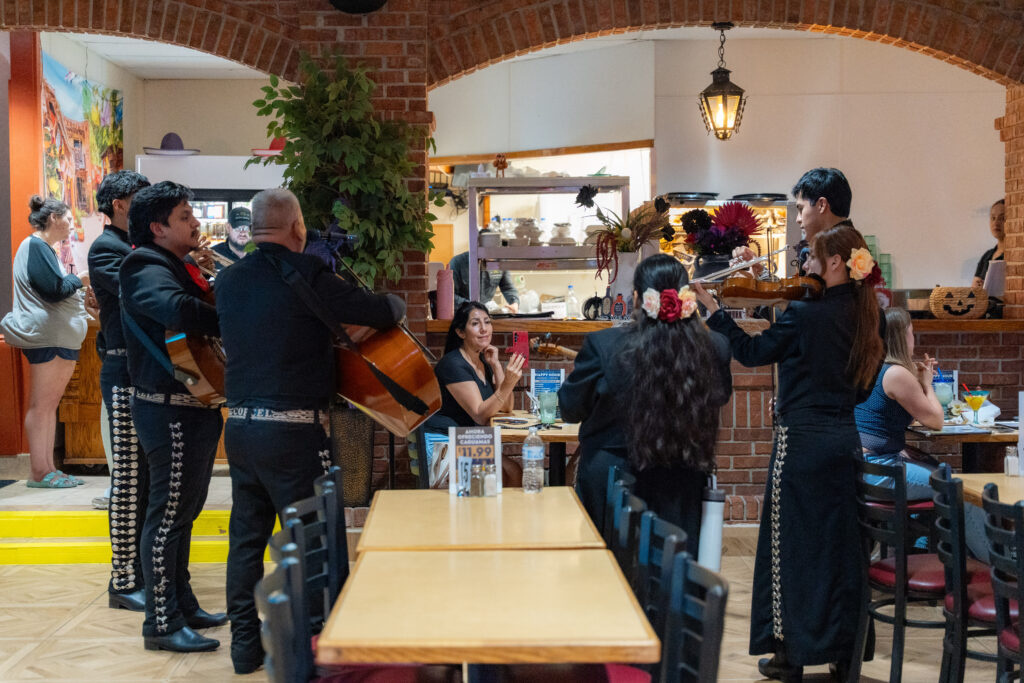
Through the humanities grant, García Oyervides has been able to survey people who have attended mariachi programming over the last year. He says that demand is coming from the growing Latino population in Wisconsin and also non-Latinos who are looking for opportunities to experience “diverse subsets of arts and folk arts.”
Zoom out further, and the demographics make sense of the demand. Mexican migration to Wisconsin dates to the early 1900s and accelerated after the 1910 revolution, with communities growing in Milwaukee and across rural farm towns. During the past decade, more than 44,000 individuals entering the federal immigration court system identified Wisconsin as their state of residence. This includes many from Mexico, Nicaragua and Venezuela, bringing with them a desire for Latin American art.
If Corcel is pushing mariachi forward in Madison, and García Oyervides in the Fox Valley area, Milwaukee has long been the state’s anchor. Mexican Fiesta, founded in 1973 by a League of United Latin American Citizens council, regularly works to normalize hearing mariachis on a main stage in Wisconsin.
From there, institutions have grown around the sound. The Latino Arts Strings Program at Milwaukee’s United Community Center — created in 2002 by its director, Dinorah Márquez — teaches classical strings and mariachi ensembles to hundreds of students each year. This institutionalization of mariachi curriculum should be a statewide goal, García Oyervides says.
Mainstream presenters have also widened the stage. In May 2024, the Madison Symphony Orchestra capped its season with an all-Mexican “Fiesta Finale” featuring Mariachi Los Camperos — the first time a mariachi group performed with the orchestra at Overture Hall.
Mariachi Corcel de Madison will follow Mariachi Los Camperos’ footsteps by performing at the Overture Center as one of many supporting acts of the Madison Symphony Orchestra’s centennial season in the spring, according to Ponce.
At Breese Stevens Field, Mariachi Corcel de Madison makes its way through a sold-out crowd of soccer fans. It is the last home game of the season for Forward Madison FC, which coincides with the final weekend of Latine Heritage Month. Corcel de Madison is there to provide a musical backdrop for the Latine-themed evening. The home team is playing well, and fans are in a lively mood, cheering on their players with horns and shouts.
The band, dressed in their charros, carefully heave their instruments, microphones and speakers to a spot in the middle of the stands. They climb to the top and count off. Ponce’s horn announces the group to the crowd and briefly competes with the horns blaring from the Flock section of the stadium. The Flock crowd notices and makes room for the music. Zepeda Brito and Real’s violins join the melody while the father and son hold down the rhythm.
Ponce lowers his trumpet and sings, “El carretero se va, ya se va para Sayula. El carretero no va, porque le falta la mula.” (The cart driver is leaving, he is leaving for Sayula. The cart driver cannot leave, because he is missing his mule.)
“El Carretero Se Va,” the classic Mariachi Vargas de Tecalitlán song that warns against embarking on a journey without being well-prepared carries through the crowd and sets the tone for the evening. Ponce lets out a grito — an emotional yell common in Mexican culture — and the crowd cheers in response.
Wisconsin is searching for mariachi, and Mariachi Corcel de Madison is prepared to bring it to them.
mariachi live in Wisconsin
Curb goes behind the scenes with the musicians of Mariachi Corcel de Madison as they get ready to perform.
Feature photo: Lead trumpeter Fernando Ponce throws his fist in the air during a performance at La Hacienda in Madison. Photo by Jonás Tijerino