The destination: the Dorf Haus Supper Club. A lively German tavern buzzing with regulars and dotted with wanderers, all gathered for the same reason — to savor the traditional taste of Wisconsin.
Skin goosebumped from the clash of unwanted September heat and relentless air conditioning, eyes squinting against sunlight bouncing sharply off dusty truck windows — it’s a scene that feels like the quiet closing of a classic summer’s end. The air is thick with the last gasp of summer, sticky and restless, with the chill of evening waiting just around the corner. Flip-flops slap the ground in a lazy rhythm; sweater sleeves are pushed to the elbows; an outfit caught between seasons, unsure whether to brace for warmth or wind. The sky hums with that particular glow only early fall evenings carry — half golden, half fading.
The driveway remains impeccably paved despite the hundreds of tires that cross it in the course of one night. Inside, the light reflects the setting sun, shifting from golden dusk to dim amber. Eyes wander toward plates and paintings, scenes of small-town Wisconsin that line the walls. The staff greets each customer with smiles that are practiced but genuine, a kind of warmth that belongs to family-owned places.
The smell of fried food drifts through the air, testing everyone’s willpower. Waitresses carry trays heavy with plates of crispy haddock, tangy coleslaw and heaping fritters the size of the stuffed animals in the claw machine by the door. Glasses clink against wooden tables as laughter ripples through the room.
Here, time stretches backward into a lineage of Friday nights spent doing exactly this.

On these nights in Wisconsin, tradition is best served battered and fried. The fish fry, a meal early European settlers brought to the state, has endured through generations of cultural shifts, political upheaval and changing tastes. This simple dish, rich in both carbohydrates and history, remains a distinctly Wisconsin staple. As common as the lakes and rivers that define the region, it’s nearly impossible for a visitor or local to avoid crossing paths with this weekly gathering. Shared by thousands across counties, the fish fry stands as a testament to Wisconsin’s deep sense of community and continuity. Dinner at the week’s end is about more than food — it’s a shared ritual to unite people.
Stemming from a strict no-meat-on-Fridays regimen, fish fries were rooted in German Catholic morals. By 1900, German-born residents made up approximately 10% of Wisconsin’s population.
Facing the social strain of Prohibition, Wisconsinites surrounded by fresh water found opportunity in the state’s lakes and rivers. If alcohol had to go, fish could stay. Frying it became an affordable, delicious way to feed families and keep taverns in business.
“You take a seasonally abundant, cheap, but unglamorous foodstuff like fish, and match it with a seductive and quick preparation technique, and voila,” Janet Gilmore, a UW–Madison emeritus professor of folklore and landscape architecture, wrote in a personal paper on the tradition.
Bars and restaurants turned their dining rooms into community hubs. Owners opened their doors to patrons looking for warmth and conversation, offering a place to escape the tension of the time. With alcohol restricted but fellowship encouraged, the fish fry became less about what was on the plate and more about who you shared it with.

“The appeal was really the ritual of it and getting out and being social on a Friday night,” says Jeff Oloizia, a Pulitzer Center StoryReach Midwest fellow.
The meal in question? Deep-fried fish, flaky enough that knives are unnecessary. Potato pancakes. Peppery, crisp coleslaw. Two slices of rye bread with butter, tartar sauce and a lemon wedge on the side. Some places add applesauce; others swap in fries or baked potatoes. But the bones of the ritual remain the same.
“In our politically polarized climate, they can still be a unifying force … We may have our differences, but many can agree on a good fish fry.”
Rebecca Maier-Frey, co-owner of the Dorf Haus in Roxbury west of Madison, finds tradition is what sticks best. While the fish used may vary from perch to haddock, the key ingredients of the fry never change. In fact, the Dorf Haus’ recipe for fritters is rooted in family history.
“My grandma — my dad’s mom — she would make bread dough, and if it wasn’t risen enough by the time dinner she wanted to make dinner, she would make fritters,” Maier-Frey says.
That small act of improvisation became the foundation of the Dorf Haus’ story.
In 1961, Maier-Frey’s father nearly died in a winter accident that forced him to close his construction business.
“He started tending bar on crutches,” Maier-Frey says. “His brother owned a restaurant about 40 minutes from here, and they started serving chicken and fish. All you could eat for one dollar.”
That is where the story of fish fries at the Dorf Haus began: a family working through hardship by feeding others. From a bustling supper club to a sibling-owned restaurant, the Dorf Haus’s tradition has carried on through resilience, baking values into every fish and fritter.
One Dorf Haus patron shared that her favorite part of a Friday fish fry is dining in a place that feels rich with family history and surrounded by the familiar faces with which she grew up.
From rural farms in northern Rhinelander to the bustling city life in Milwaukee, it’s all about the family and the fish on Friday nights.
Fish fries are as much a lively social phenomenon as they are vital community events, Gilmore says.
Jeff Stoll of the popular Stolley’s Hogg Alley, roughly 30 miles west of Milwaukee, says his fish fry has been the same for 19 years, a consistency that keeps drawing people back.
And come back, they do. By the end of the week, the Dorf Haus is buzzing with pagers in every hand, and the Stolley’s Hogg Alley bar stays filled with regulars waiting for a coveted patio table. Kids dart across the dark carpeted floors of the Dorf Haus while dogs relax in the grass outside Stolley’s. Older couples savor the first sips of their Wisconsin-style old fashioned.
These nights have a familiar rhythm, a kind of dance everyone seems to know the choreography to.
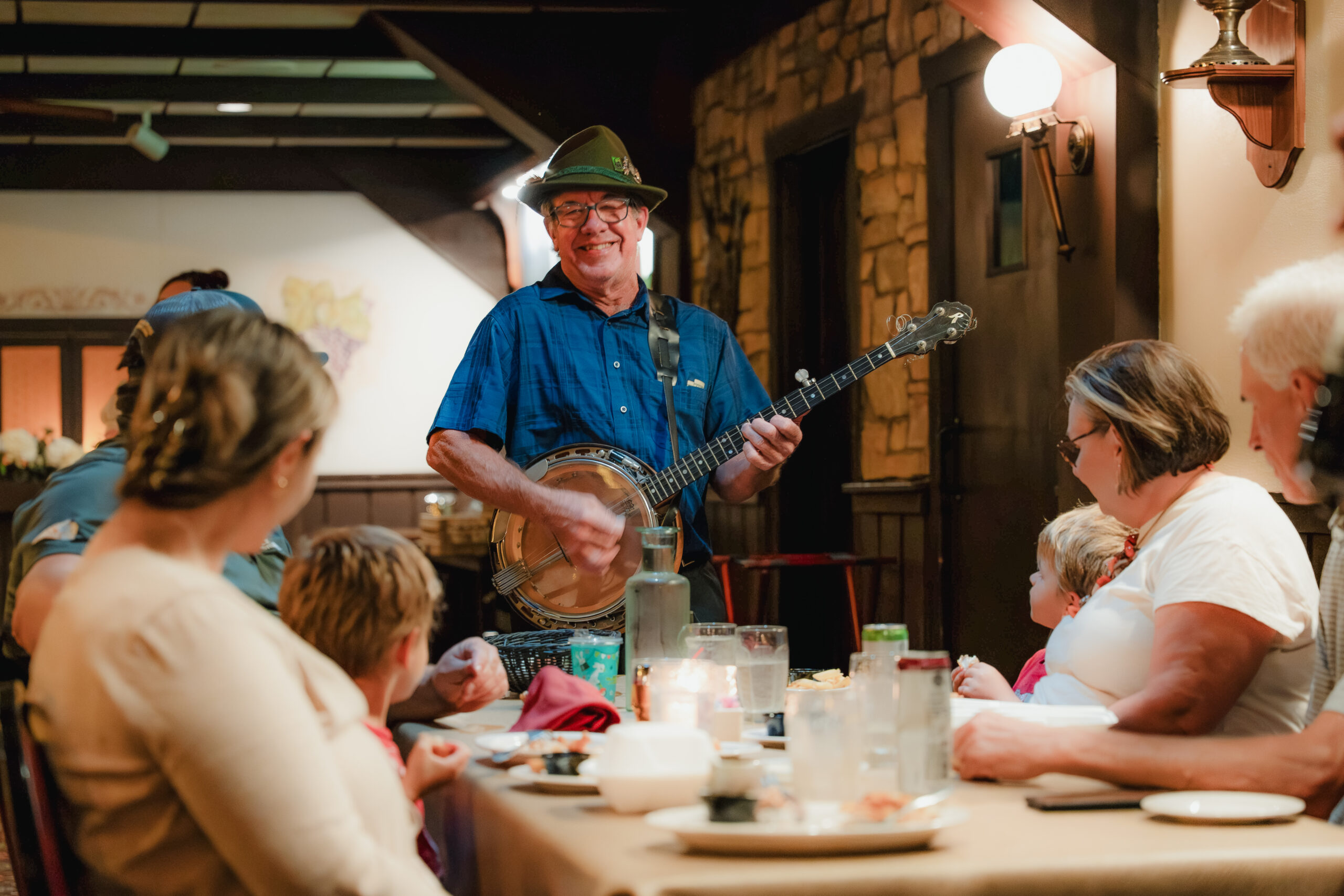
Monte Maier, Rebecca’s brother and co-owner of the Dorf Haus, loves the lively music and good moods Fridays bring about. True to its name, German for “small village inn,” the Dorf Haus captures that cozy charm with its collection of German china and mallard decoys lining the walls.
The wait at the Dorf Haus adds to the experience, allowing for extra dancing time and friendly conversations. Before the buzzer glows red, meaning a table is ready, guests can wander through the newly added back room and patio, gaining a fuller sense and familiarity of the well-worn house.
Many drift from table to table, exchanging stories about their favorite Fridays or debating whether a Wisconsin old fashioned truly surpasses a regular one.
“Most of these places don’t take reservations. You’re going to go, you’re going to wait, you’re going to see a lot of the same people, and it’s all part of the experience,” Oloizia says.
Staff members dressed in dirndls weave between tables, pausing for side chats with customers or to check in on family members working beside them. Maier-Frey’s great-niece is working in the other room, and her son and husband are in the kitchen.
For fish fry enthusiast and Milwaukee Record contributor Caleb Westphal, the meal has been more than a decade-long pursuit. His “Enjoy Every Fish Fry” series has taken him to hundreds of spots across the state.
While Westphal values the food, the ambience and tradition also matter.
“I suppose in the end it really comes down to creating a space where people can come together to share in a tradition,” Westphal says.
“I think that it’s [the ritual of fish fries] as meaningful to young generations as it is to older ones,” Oloizia says. He adds that “what gets put on the plate might change.”
As Wisconsin’s climate warms, fish fries are also adapting. Warmer water temperatures and invasive species have disrupted spawning patterns across the Great Lakes. Yellow perch, once a local favorite, has declined sharply, and some restaurants now import fish from Canada or the Atlantic.
“Even [Atlantic] cod is getting more scarce and more expensive,” Gilmore says. “There is a lot of shifting around depending on what’s available.”
As the accordion fades into a murmur and the last fruity cheesecake disappears at the Dorf Haus, children yawn and conversation softens beneath the glow of barn paintings and beer signs. Another Friday comes to an end.
Across Wisconsin, people keep finding time to sit together, share a plate and celebrate the generations before them. But as lakes change and local fish disappear, questions linger.
Will it continue to matter that this meal is no longer truly local? Or will the families behind each fry find new ways to carry on the ritual?
“They bring families and friends together, and tie us to the generations that came before us,” Westphal says. “In our politically polarized climate, they can still be a unifying force … We may have our differences, but many can agree on a good fish fry.”
Serve up the House Special
Flaky, crisp and the star of every Wisconsin Friday
In a state shaped by its lakes and rivers, it’s only natural that fish has become a staple of the Wisconsin diet. Whether you’re a perch purist or a cod loyalist, the Wisconsin fish fry is a recipe for connection, serving equal parts flavor, nostalgia and Friday-night magic.

Feature photo: A rare sight — the two-man-band spotted on stage at the Dorf Haus. When they’re not posted at the front of the dining hall, they bob and weave through the crowd, keeping every patron and staffer entertained. Photo by Jonás Tijerino