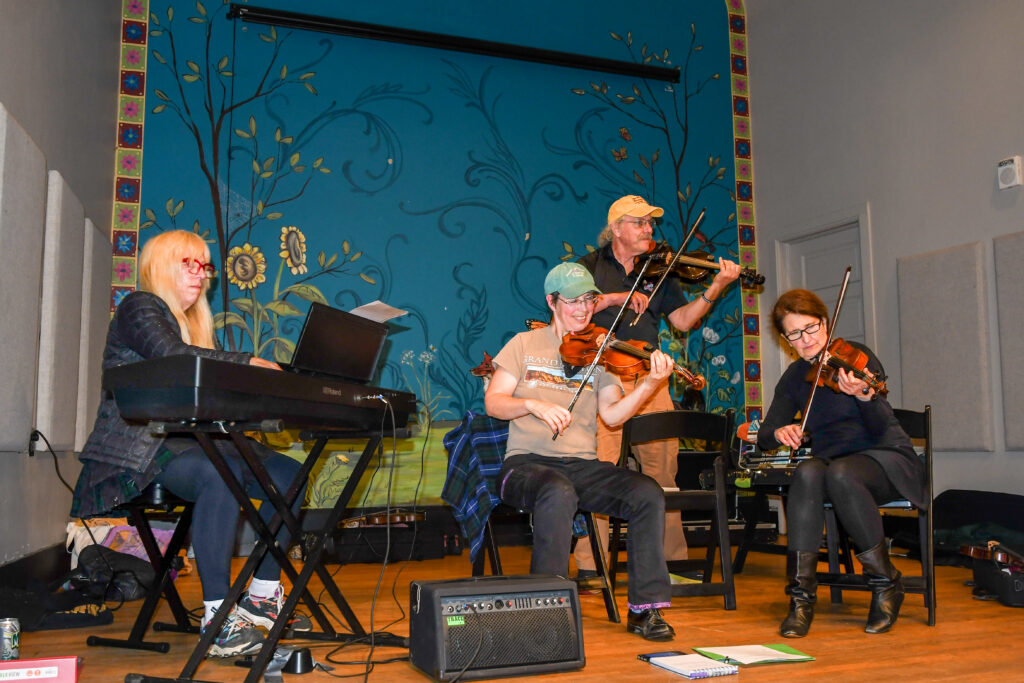
A standing bass plays four notes — dum, dum, dum, dum.
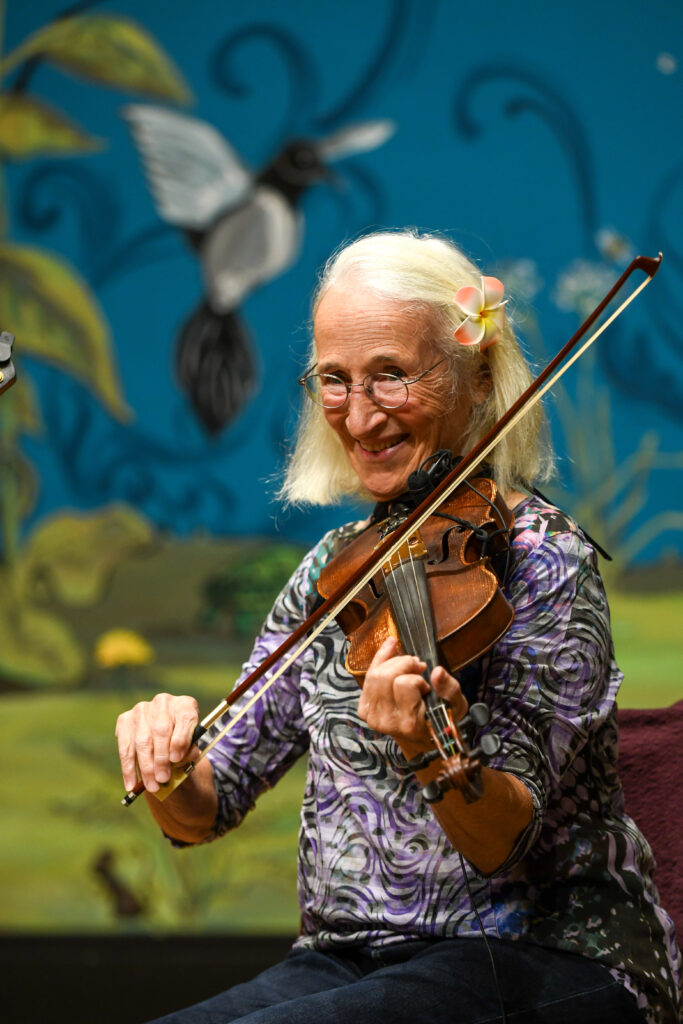
The fiddle joins, a light and lilting tune.
Then the guitar fills out the texture with strong, rhythmic strums.
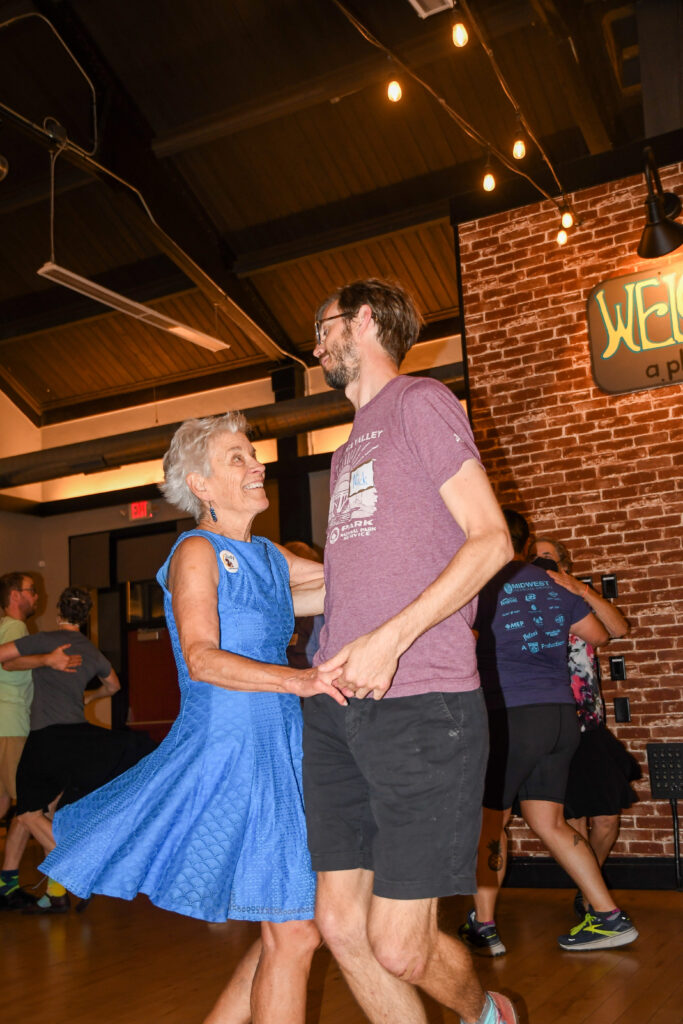
The players sit on a small stage at the head of the ballroom behind a woman calling out moves. Dancers’ feet stamp the ground, skirts twirl in the air and spirited whoops echo in the large room, reverberating off the walls. Familiar faces smile at each other, bodies falling into a shared rhythm silently negotiated over their encounters. Strangers enter each other’s spaces. A newcomer with timid energy meets a dancer, their senior — the experienced partner — who gently guides them, so subtle the newcomer simply feels the magic.
This is an average Tuesday night at Wil-Mar Neighborhood Center’s weekly contra dance, which over the last several decades has transformed tradition.
Contra is a type of folk dance with long lines of couples, similar to square dancing in that there’s a “caller” who provides instructions for each dance. Developing in the New England and Appalachian regions, contra dance has mixed origins from English, Scottish and French dance styles of the 17th century.
Each dance is around 15 minutes, after which everyone is meant to switch partners, which is what makes it community-oriented. Couples also move up and down the line, dancing with a different set of partners each time the pattern of steps is completed.
In recent contra history, ladies and gentlemen danced in couples with men as the lead and women as the follow. Those who wanted to diverge from those expected gender norms often received pushback. Now, many Wisconsin contra dances have removed gendered terms entirely. These changes have made the community a safe space where queer and transgender dancers can experiment with gender expression and find their identity — part of a movement reshaping contra dance into one of the country’s most welcoming spaces for LGBTQ+ people.
When Summer Shay, who uses she/they pronouns, attended her first contra dance festival, she identified as a man. When she saw other men in the room wearing skirts, she went out and bought the first of her own, not knowing what the future would hold.
“[Contra] was a place where I felt safe to try things on and experiment and see how I wanted to present,” says Shay, a transfeminine nonbinary dancer and caller who established her identity with the help of contra. “[It’s] not something that I had really been exploring before that.”
passed among dancers around the country. Photo by Mary Bosch
Starting with Les be Gay and Dance in Minnesota in the 1970s and the Lavender Country Folk Dancers in Boston in 1988, gay and lesbian contra dance groups began the gender-free contra movement. At the Boston LGBT dance, those in the traditional gents role wore arm bands, and the roles were bands and bares. At Les be Gay and Dance, callers like Carol Ormand, who attends contra regularly in Madison, worked to change the dance form by removing role titles entirely and using positional instructions.
Talk of gender-free contra dance became more mainstream in the 2010s, with the roles of Lark — the left — and Robin — the right — emerging as the standard. Contra organizers changed Raven to Robin, as a Tlingit woman in Alaska did not want to be referred to as Raven because her tribal binary kinship, or moiety, was an Eagle. Organizers also researched moieties across the country to ensure Lark and Robin had no crossover.
Spread through contra dance festivals, by 2019 there were 24 dance series across the nation using gender-free calling, including one in Madison.
Contra and square dance communities are majority white, but despite appearances, square dance has deep African American history rooted in slavery. Enslaved African American fiddlers and musicians were forced to play for white American dances. Although white dancers originally learned by memorizing steps from dance masters, enslaved people adapted popular dances among themselves by calling out the steps, which they eventually did for white dances as well.
Modern historians point to how square dancing was used as a tool of white supremacy in America. Henry Ford, founder of the Ford Motor Company, campaigned for square dancing in physical education classes and poured money into promoting square dance as a tool of white supremacy to guard white and black people from the popularity of jazz, which he believed — as an antisemite — was an evil “Jewish creation.”
“Dance with who’s coming at you”
Before gender-free terms were widely introduced, it was common for women dancing the traditional gentleman role to wear ties around their arms as a visual marker for other dancers who might otherwise assume they were in the lady role.
“Some person walked up to me with a tie in his hands,” Penelope Weinberger says, recalling a dance in Wilmington, North Carolina. “He says, ‘If you’re gonna dance the gent, you have to wear a tie.’”
She recalls saying, “No, I don’t have to wear the tie, and I’m not going to wear the tie.”
He responded, “The new dancers are going to be confused.”
“The new dancers are going to be confused, but not by that,” Weinberger says she told him. “The only person who’s going to be confused about whether I’m wearing a tie or not are people like you.”
Weinberger started making “Dance with Who’s Coming at You” T-shirts out of frustration with situations like this.
She also believed in the move toward nongendered calling to emphasize that anyone can dance any role, which was said but not always encouraged. Unlike many partner dances, contra is not a true lead-or-follow dance, as the caller is the leader and either partner can lead in certain moments.
Men’s attitudes also affect other men. Erik Ewald, another longtime dancer, prefers to dance the traditional lady role, and he experienced significant resistance before the larger shift to gender-free calling.
Especially in situations where there were more men than women, some men would become frustrated when two women danced together because it would cause a gender imbalance.
“Some very homophobic people will just want to swing two-handed. There were males who would flat out not swing me if I’m in the Robin position,” Ewald says. “Then if I were dancing with a femme-presenting person, we’d swap, and the next time we’d come up to that couple, I would have my partner not swing that Lark.”
These patterns emerge today, with male Larks not spinning masculine-presenting Robins as much as their feminine-presenting counterparts. However, Ewald also explained that many males were inspired to be increasingly physical with him because he’s closer to their size.
The story of Madison Queer Contra
Queer contra started in Madison simply because queer people wanted one. Shay, along with friends and co-founders Milo Pierick, Violet Martin-Millar and Caide Jackson, was inspired by Chicago queer contra.
Pierick brought the bit of “you can just do things” energy they needed. They all lived in housing cooperatives and were able to book the Ambrosia Cooperative for the first dance. Planning involved starting a Facebook group, using some documents shared from Chicago queer contra and making an announcement at the Wil-Mar Neighborhood Center Tuesday night dance.
The first dance, in September 2019, drew about 30 people. Numbers grew, and up to 50 dancers attended Madison Queer Contra, which was eventually hosted at the Wil-Mar Neighborhood Center.
“I remember being amazed when the queer contra dance was starting,” says Noah Natzke, a dancer and caller who started in 2012. “I was wondering, ‘Where are we going to find dancers for this?’ and there were tons of people who came … it’s exposed me way more to trans people and all sorts of diversity in that area, which is good because it’s not in my usual circle.”
Eventually, both Madison Queer Contra and the weekly Tuesday dances paused due to the COVID-19 pandemic. When Shay returned to Madison after moving to the Twin Cities, she questioned whether to restart the Madison Queer Contra. However, she felt the Tuesday dances were a welcoming and queer space, so there was no need. The legacy lives on through the organizers and community.
How contra dance changes you
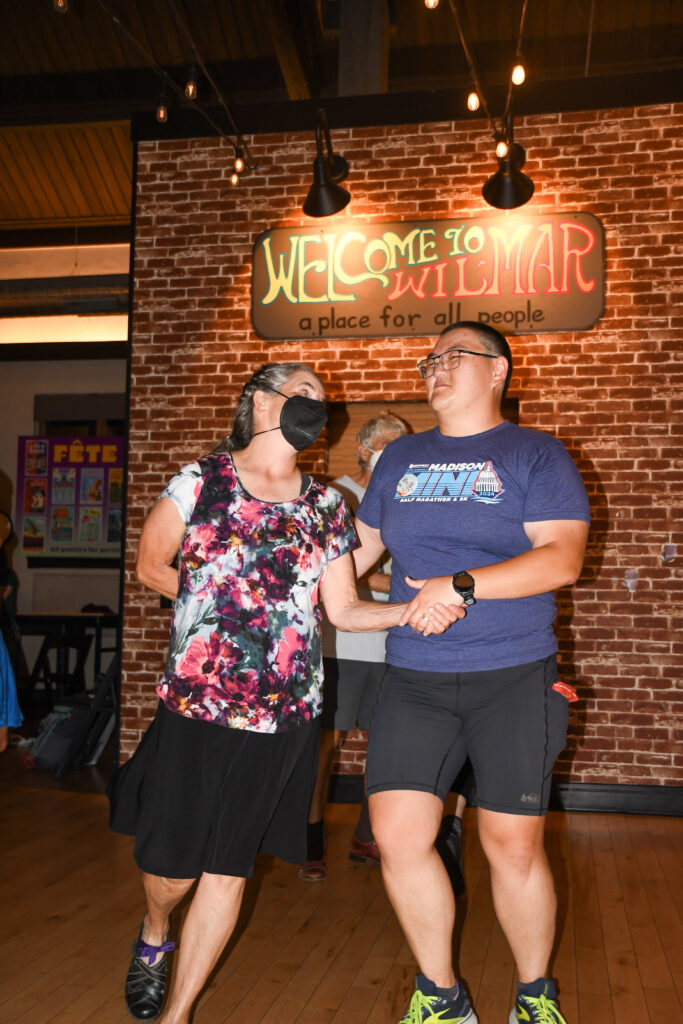
For Piper Koch, a UW–Madison student who started dancing in February, the physical closeness was the strangest part of her first contra dance.
“It was weird just being close to other people and random strangers,” Koch says. “You’re right in front of them, you’re making eye contact with them and sometimes it’s also totally, completely quiet.”
Koch didn’t have any prior dance experience and clung to the friend who had brought her that first dance. During the beginning of a dance, when everything’s being explained, it’s common to stand still listening to the caller while holding your partner’s hand.
This was initially nerve-wracking for Koch, but over time, she was transformed.
“Now I can just stand and hold hands with somebody for five minutes, and I don’t care,” Koch says. “I could not do that nine months ago.”
Koch grew to love the formality and politeness of contra dance. Many contra dance newcomers go through similar experiences, including Noelle Gibeson, a 33-year-old nonbinary dancer.
Gibeson, who uses she/they pronouns, started contra dancing before the pandemic, similarly intimidated by strangers and eye contact. They weren’t sure if they would ever go back, but post-COVID-19, they pushed themselves to attend in search of community. Their second dance weekend, Chambana Jam Jan in Urbana, Illinois, “put [them] head over heels with contra.”
“I remember being amazed when the queer contra dance was starting.”
Koch and Gibeson have only ever learned gender-free calling, and they both feel comfortable in and enjoy dancing both roles. They note that the main difference is that the Lark adds extra flourishes to twirl the Robin more.
Nonetheless, the space is open to all.
“I felt very welcomed at contra. I think the presence of other queer people helps with that,” Gibeson says. Now, Madison’s contra community is the youngest and probably the queerest it’s ever been with a mix of college students, young professionals and more experienced dancers.
“I think a lot of the younger folk who do contra are queer … if you want the arts to keep thriving, you need younger folks,” Gibeson says.
Both Gibeson and Koch now plan their lives around contra dance. Gibeson schedules vacations around dance weekends, while Koch planned her class schedule to never miss a Tuesday night.
When the final dance concludes, the bass echoes in the hall, the fiddle’s tune sings its last melody and the guitar strumming fades into the night.
Contra Dance 101
Take a spin with Curb to learn six essential contra moves
Join editor Mary Bosch to learn a few basic contra dance moves like the balance and swing, do-si-do and the promenade.
Feature photo: Skirts fly as couples swing, spinning together with circular momentum. Photo by Mary Bosch