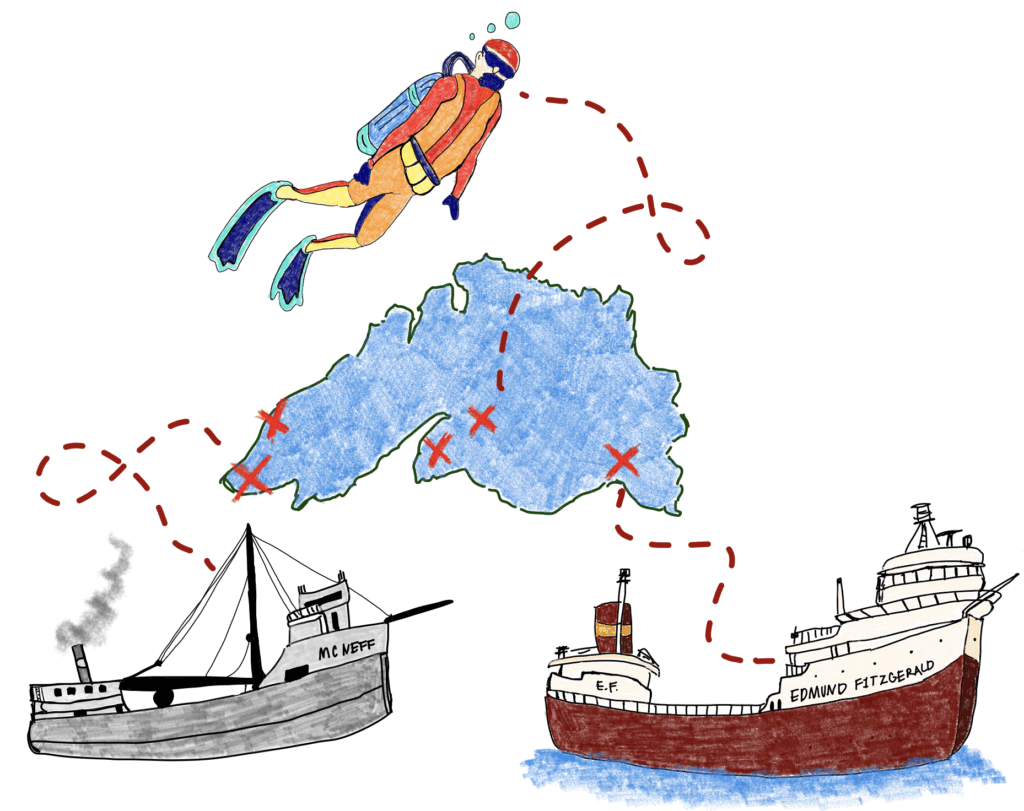
The hundreds of shipwrecks in Lake Michigan and Lake Superior provide an economic and cultural history of the state. Here are five historical ships with winding journeys to the bottom of the Great Lakes.
The Lucerne set off on its final voyage from Ashland on Nov. 15, 1886, with a load of iron ore. A storm hit the ship the next night, and a lighthouse keeper found the wreck in Chequamegon Bay in Lake Superior the next morning — it sits there today in 24 feet of water.
The Ira H. Owen set off from Duluth, Minnesota, on Nov. 28, 1905, but the weather worsened as the vessel moved into open water. Another ship’s captain saw the Owen struggling but couldn’t help in the storm. Two days later, another ship spotted the Owen’s wreckage.
In 1909, the M.C. Neff was unloading cargo at the Superior Shipbuilding yard when a fire broke out. The crew decided the ship couldn’t be saved, so they let the burned Neff sink.
The Frontenac left Silver Bay Harbor in Lake Superior on Nov. 22, 1979. The reef of a nearby island damaged the ship’s hull during a snowstorm. It was towed back to Duluth, but the damage was so severe that the vessel was considered a total loss.
The Edmund Fitzgerald left Superior on Nov. 9, 1975. The next day, a storm with 40- to 60-knot winds and 10- to 25-foot-high waves hit. The captain of another ship radioed the Fitzgerald’s Captain McSorely, who replied, “We’re holding our own.” Ten minutes later, the Fitzgerald dropped from radar. In 1976, Gordon Lightfoot immortalized the wreck with the song, “The Wreck of the Edmund Fitzgerald”.
Source: wisconsinshipwrecks.org
Feature photo by Jonás Tijerino