Dickeyville is a sleepy town with a funny name, nestled among the Driftless Area’s gentle dips and curves in terrain — just off of Highway 151 as it meanders south toward Dubuque. This is the sort of place an oblivious roadtripper might pass over or pass through, its streets lined with rows of compact, ranch-style homes with neatly manicured lawns and tidy front gardens.
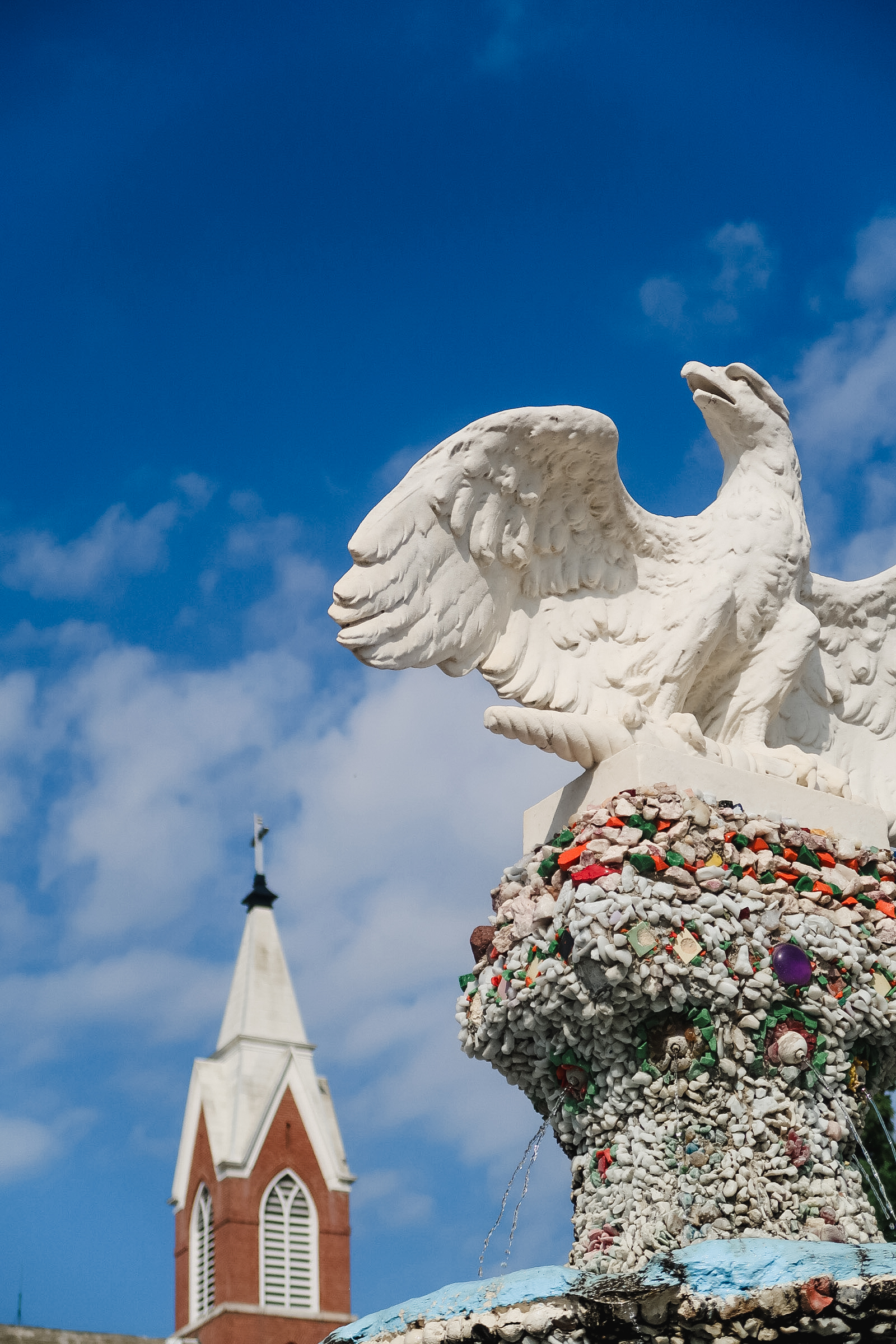
Dickeyville’s downtown, in typical Midwestern fashion, has a diner, a tavern and a used car dealership, among other things. The only building over two stories is the red-brick Holy Ghost Catholic Church that sits at the town’s center, its slender, white-topped spire pointing heavenward.
The town’s population barely grazes 1,000. One gets the impression that not much happens here. But ordinary as it may seem, Dickeyville is home to something that’s quite out of the ordinary — and impossible to miss.
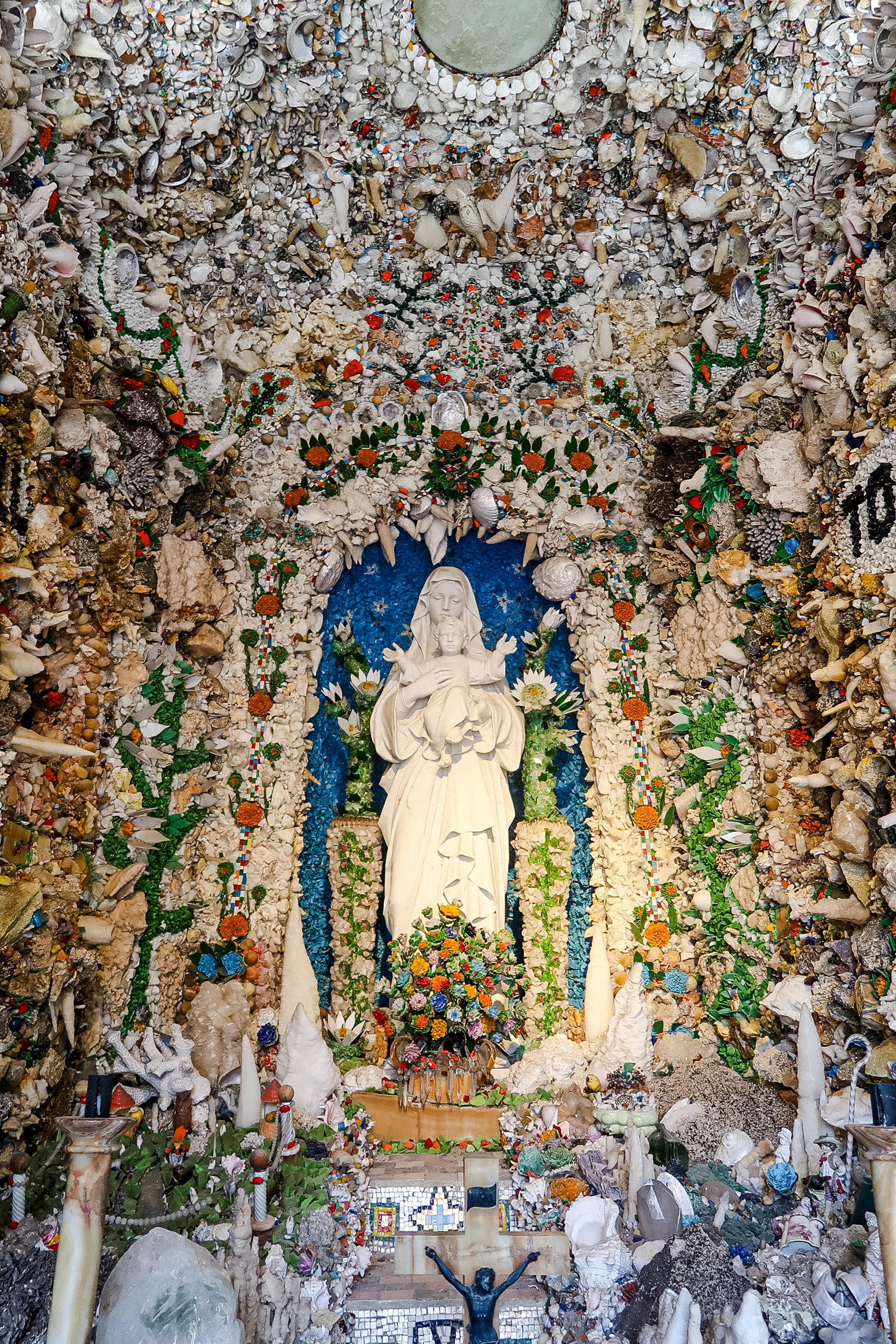
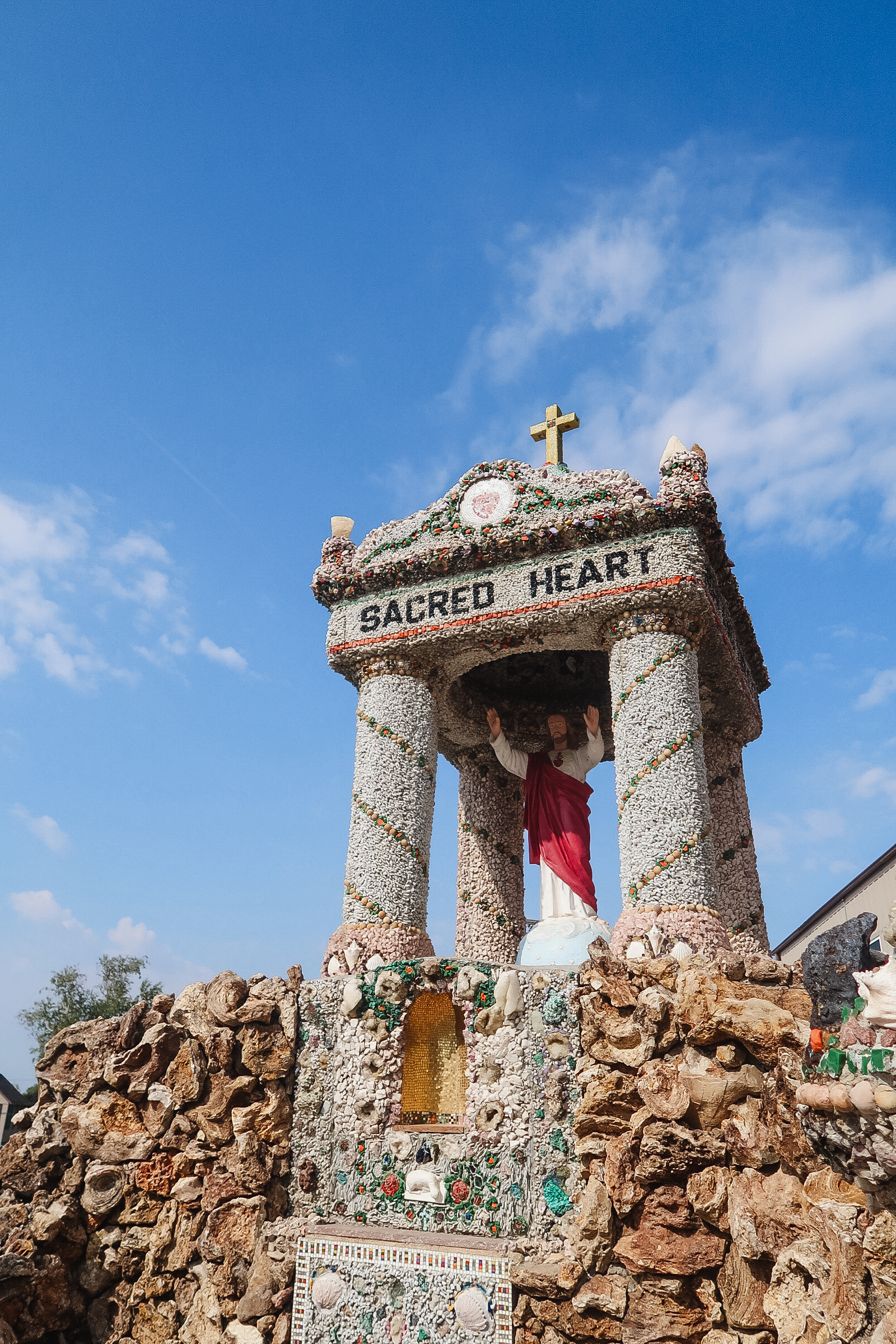
You’ll find it alongside the Holy Ghost Catholic Church: a strange, intricate concrete structure (or is it a sculpture? an art installation?) inlaid with gemstones, shells, broken glass and other found objects. This overwhelming feast for the eyes is the Dickeyville Grotto, a curio of a bygone era that’s made this little Wisconsin town a tourist hotspot for nearly 100 years.
The Midwest has one of the highest concentrations of grottos, which are human-made caverns, in the United States — Dickeyville Grotto among them. Despite being almost a century old, the grotto and its surrounding shrines continue to draw thousands of visitors a year, including Catholics on religious pilgrimage, art enthusiasts, history buffs and curious passersby.
The Dickeyville Grotto is a work of folk art: an amalgamation of the natural environment that surrounds it, the politics of the era it was built in and the unique material culture of the Midwest. Experts say we’ll lose a piece of Wisconsin’s history and folklore if this precious art environment and other folk art environments aren’t preserved.
“With a lot of what we might call fine art … there’s a real emphasis on the individual, on innovation, on novelty and their own distinctive, unique voice,” says Anna Rue, the director of the Center for the Study of Upper Midwestern Cultures at UW–Madison, who holds a doctorate in Scandinavian studies. “And within a folk art practice, the emphasis is a bit more on community expression.”
Folk art is shared informally and contains variation, Rue says.
Folk art surrounds us: While works can certainly be found on display in museums and galleries, they’re also often hidden in plain sight — in backyards or family homes, shared spaces or private residences. Common forms like patchwork quilts and handmade furniture are functional, but others are just odd, like statue gardens and grotesque concrete sculptures.
Works of folk art may be deeply rooted in longstanding cultural traditions, but that doesn’t mean they’re immune to change.
“There are constantly new modes of expression that are emerging, and there are ways that we revitalize old traditions and make them new and relevant,” Rue says. “These are not static practices.”
The grottos of the Midwest, the majority of which were built in Wisconsin and Iowa in the early to mid-20th century, are no exception.
“The Midwest is super wild and weird and really wonderful in a way that I don’t think people appreciate,” says Laura Bickford, curator at the John Michael Kohler Arts Center in Sheboygan, who recently put together an exhibition about Midwestern grottos. Naturally, that wonderful weirdness is manifested in the grottos that are scattered throughout the region.
Common grottos are artificial caverns for prayer and worship, and Midwest grottos fill that religious niche. The Dickeyville Grotto was built by a German Catholic priest, Father Matthias Wernerus, from 1920 to 1930, and it has no shortage of Catholic iconography.
But where Midwest grottos diverge from the rest, Bickford says, is with their incorporation of found objects into their form. Each trinket, bauble and knickknack embedded in the Dickeyville Grotto’s mortar facade tells a story — you just need to know how to decipher it.
Look closer
Jennifer Digman, the director of the site, can.
“Every piece has some special meaning,” she says.
Dickeyville Grotto might have been built by Wernerus alone, but he had lots of help when it came to gathering its materials. Folk art isn’t an expression of individuality — it’s a physical manifestation of a community’s shared values, culture and history, and it tells a story.
In this small Wisconsin town, that story is told by the various bits and bobs donated by the people who resided here 100 years ago: teacups, broken china, little glass figurines and family heirlooms.
“People didn’t have money to give, so they would give whatever they could that was precious to them to be a part of [the grotto],” Digman says.
As a result, the grotto is more than a work of art or a place of worship: It’s a time capsule of hidden curiosities, frozen in time.
These human-made found objects tell the history of a town, but natural materials — like rocks, fossils and shells — tell the history of the land.
To begin with, the Dickeyville Grotto, as stoic as Stonehenge, appears to be an extension of the land itself.
Visually, it recalls the organic, rounded form of Spain’s Sagrada Familia — how it almost seems to sprout from the earth. There are no sharp edges to be found, none of the pillars and swooping buttresses that characterize Catholic churches in Europe.
Examine the grotto more closely, and its connection to the natural world becomes even more discernible. Lodged among the human-made trappings of 20th-century life are shells, stones, fossils, and other bits and pieces of the natural world. There’s blush-pink rose quartz from South Dakota, a fossil from Lake Michigan, native unglaciated rocks, and stalactites and stalagmites from Iowa, Digman says.
The organic mingles with the human-made, and the grotto sits at the intersection of modern human expression and the natural world.
All-American
The Dickeyville Grotto and its surrounding shrines are works of art and places of worship — that’s undeniable. But one of the shrines serves a different purpose: to assert its architect’s American patriotism.
Wernerus arrived in the United States in 1904 to answer a call for German-speaking priests and settled in Dickeyville in 1918 — a time when, as World War I was reaching its end, anti-German sentiment in the U.S. was boiling over. Perhaps to build rapport with his new neighbors and reinforce his American identity, Wernerus constructed the aptly named Patriotic Shrine — a tribute to the United States that’s as delightfully kitschy as it is stunning.
This shrine’s steward isn’t the Virgin Mary or Jesus Christ. Instead, it’s watched over by Christopher Columbus, who’s flanked on either side by statues of Abraham Lincoln and George Washington. And of course, there’s a statue of an eagle, wings outstretched and beak agape, perched atop the fountain at the shrine’s center.

The message is clear and intentional: The man who built this shrine is an American, through and through.
“Those impulses … to use an ethnically informed cultural, artistic expression to articulate belonging in an American context is something that many artists have done in the past,” Rue says.
And thus, Wernerus used an uncommon work of art to bond with Dickeyville’s common folk.
Folk revival
Upon its completion in 1930, the Dickeyville Grotto became a tourist attraction and a religious pilgrimage site that never ceases to amaze visitors, Digman says.
“The passion that [Wernerus] put into it — it’s something that you can’t replace,” she says.
But after nearly a century of exposure to pollution and Wisconsin’s harsh weather patterns, the grotto deteriorated. Mosaic tiles, shells, glass and stones were dislodged from the mortar, leaving yawning cavities in their wake. Fissures, like crooked smiles, split open its facade.
Dickeyville needed to take action before its time capsule became officially defunct, but revitalizing the grotto would be no small feat.
“The great neighbor next door that just wants to help out, they don’t always have that tender hand that you need for this kind of work,” says Beth Wiza, the preservation project manager at the Kohler Foundation, a nonprofit organization (unaffiliated with the Kohler Arts Center) with a mission to support the arts and education.
“The passion that [Wernerus] put into it — it’s something that you can’t replace.”
It was the Kohler Foundation that headed Dickeyville Grotto’s restoration project, hiring Heritage Preservation and Design, a family-owned preservation company with six generations of masonry conservation experience, to conserve the artwork.
After much planning and discussion, the preservation process began in 2022 with Heritage cleaning the grotto to evaluate its state before completing repairs to the structures and artworks in 2023, reattaching and replacing dislodged minerals, shells and other materials.
When the process was complete, the grotto and its surrounding shrines were restored to their former glory, as good as new.
“Let’s make it last forever,” Wiza says. “The Roman Colosseum can still be around — so can the Dickeyville Grotto.”
Most things don’t last forever. But for now, the Dickeyville Grotto — Wisconsin’s own little Colosseum — remains to be a strange, endearing, surprising, gaudy and deeply meaningful work of religious folk art. It’s a testament to the nuances of the American immigrant experience, the enduring quirkiness and natural beauty of the Midwest, and a town’s shared identity.
That’s worth preserving.
Wisconsin’s roadside attractions
These works of folk art, strange sculptures and kitschy roadside oddities are worth a stop on your next roadtrip!
Feature photo: The Dickeyville Grotto sits right off of Dickeyville’s main street, next to the Holy Ghost Catholic Church. Photo by Elsa Englebert